
Ground-mount solar: built for the long haul
Ground-mounted solar can generate more from the same panels. On a Taranaki farm, the structure underneath has to last as long as they do.
Ground-mounted solar is becoming increasingly popular across New Zealand farms, and for plenty of properties it can be one of the best ways to maximise solar performance.
Unlike a roof-mounted system, we are not restricted by the pitch, direction, or layout of an existing building. A ground mount gives us the freedom to position the panels at the optimum orientation and tilt for the site, while designing row spacing to minimise shading and maximise generation throughout the year.
That can mean significantly more generation from the same number of panels compared with a roof where we simply have to work with what we have got.
Over the life of a 25-year solar system, those gains can add up to a significant amount of extra energy.
Built for 25+ years
There is another side to ground-mounted solar that deserves just as much attention as generation.
If the solar panels sitting on top are designed to keep producing electricity for 25 years or more, the structure underneath them needs to be designed with that same timeframe in mind.
A ground mount is not just something to hold the panels up on installation day. It becomes a permanent piece of farm infrastructure, exposed to the weather every day for decades.
Taranaki can be a harsh place for solar
Taranaki is a great place for solar, but it can also be a harsh environment for anything sitting out in the open.
A ground-mounted array has to deal with strong winds, driving rain, changing ground conditions, corrosion, and the general wear and tear that comes with life on a working farm.
Unlike a roof-mounted system, there is no existing building structure underneath it. The foundations, posts, rails, fixings, and panel support all form part of the system, and they all need to be considered for the long term.
Not all ground-mount systems are the same
As farm-scale solar grows, more ground-mount options are coming onto the market at a wide range of price points.
The upfront cost matters, but the mounting structure is not somewhere to look only at the cheapest option.
If the panels sitting on top are designed to keep producing for 25 years or more, the structure underneath them needs to be designed with that same timeframe in mind.
So when comparing systems, look beyond the panels and inverter. How substantial is the structure? How are the panels supported? How will it perform in strong winds? What are the foundations like? How will the materials cope with decades of exposure? And will it still be practical to maintain and service in 10, 15, or 20 years?
These are not particularly exciting questions when you are buying solar, but they matter when you are investing in infrastructure that is expected to remain on the farm for decades.
The ground underneath matters
Every site is different, and Taranaki is a particularly good example of why.
The land around Taranaki Maunga has been shaped by a long history of volcanic activity, and ground conditions can vary considerably from one property to the next.
On one farm, deep soil might suit a conventional driven-pile system. On another, you can encounter dense volcanic material, buried rock, or softer and wetter ground that requires a completely different foundation approach.
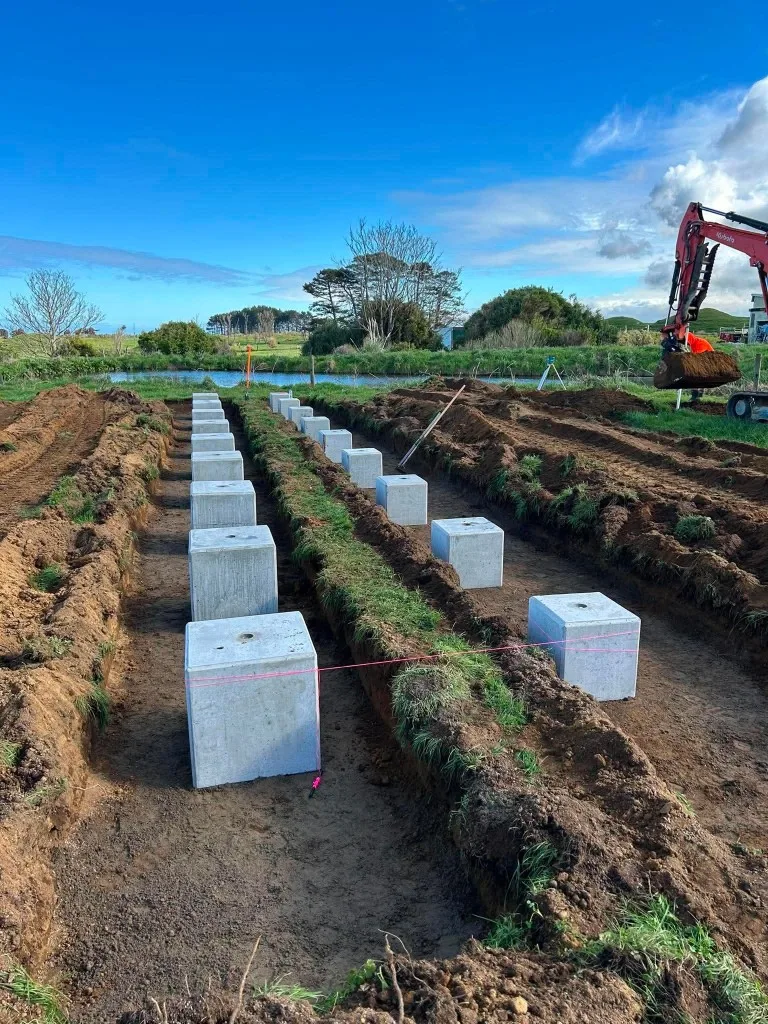
On the project pictured here, once the ground conditions were understood, we moved away from a standard driven-pile approach and used engineered concrete foundations to create a strong and consistent base for the array.
The right foundation should be determined by the site, rather than assuming one approach will work everywhere.
The panels need proper support too
Modern solar panels are remarkably strong, but they are designed to be supported and clamped in particular locations.
A well-designed mounting structure distributes loads correctly through the panel frame and limits unnecessary movement under wind loading.
Over time, excessive movement or incorrect support can place additional mechanical stress on a panel and contribute to micro-cracking within the solar cells. Those cracks may never be visible from the outside, but they can affect the long-term performance and reliability of the module.
When you have tens of thousands of dollars’ worth of panels expected to operate for decades, the structure underneath them should not be an afterthought.
Designed around the farm
A good ground mount also needs to work as part of the farm.
We think about mowing, weed control, drainage, pest control, cable access, servicing, safe access to individual panels, and the potential for future expansion.
These things can seem minor during installation, but they can make a significant difference to how practical the system is to own and maintain over the next 25 years.
There is more than one way to get there
That does not mean every ground mount needs to come out of a box or be completely supplied by us.
We have seen some magnificent farmer-built ground-mount structures, and we are happy to work alongside customers who have the skills, equipment, or local contractors to construct their own.
The key is talking to us early. We can provide the panel dimensions, rail and mounting spacings, orientation, clearances, and other requirements so the structure is designed around the solar equipment from the beginning.
The important part is not who builds it. It is making sure it is built for the job.
A long-term infrastructure investment
Ground-mounted solar can be an outstanding option for farms. It gives us the freedom to optimise orientation and tilt, maximise generation, build larger systems, and allow for future expansion without being constrained by an existing roof.
But the panels and inverter are only part of the investment.
If we are installing solar panels designed to generate electricity for 25+ years, the structure holding them up should be designed to go the distance as well.